Tag Archives: Donald Trump

View from the US: The Rise of American Progressives

Erin Caddell of GK Strategy’s American partner Anchor Advisors examines the ideological battle reshaping the Democratic Party and what it could mean for investors, corporates and the future direction of US policy

Sir Isaac Newton’s Third Law of Motion, published in 1687, states that for every action there is an equal and opposite reaction. This centuries-old theorem may go some way toward explaining the ideological split currently occurring in the U.S. Democratic party – one that could carry significant importance for the congressional midterm elections in November 2026 and for U.S. policy for many years to come.

Republican President Donald Trump faces a difficult political backdrop approaching the midterms, often thought of as a referendum on the incumbent U.S. president’s first two years in office. Trump faces sagging approval ratings in his second term, with notable weakness on his handling of the economy due to rising inflation, as well as a Middle East war with no easy way out. As this column has noted before, Republicans are already defending one of the narrowest House majorities in American history (218-212, with four vacancies and one independent).

Given these dynamics, many Democratic leaders and pundits have suggested the party employ a midterm campaign version of Napoleon’s military adage to never interrupt your enemy when he is making a mistake: focus voters’ attention on Trump policies that many voters view unfavorably rather than on promoting a robust alternative agenda. To these strategists, the poster child for the ideal Democratic candidate in 2026 is Roy Cooper, a two-time former governor of North Carolina running for U.S. Senate in that state with the simple slogan “Make Stuff Cost Less”. Cooper focuses fairly narrowly on criticizing Trump actions that he argues have resulted in “farmers… getting crushed by tariffs” and “families… seeing prices rise at grocery stores and restaurants.” In response, Cooper proposes a modest set of reforms such as tougher anti-trust enforcement and making data centers pay more for the power they draw from public utilities.

Cooper may well reach the Senate – he has run ahead of his Republican opponent in every poll published since the race began. But the middle-of-the-road approach of Cooper and other moderates is not capturing the hearts of Democratic voters writ large. The hard-edged governing style of Trump and his Republican congressional allies, in areas ranging from immigration enforcement to foreign policy to social spending, has, to use a scientific term, made Democrats mad as hell. And – returning to Newton’s Third Law – Democrats want their leaders to push back hard at Trump with policies equal and opposite to those promulgated by the GOP-led Administration and Congress.

Evidence of Democrat voters’ more confrontational impulse is ample in recent party primaries to select candidates to run in the November congressional elections. In June, two progressive U.S. House candidates running to represent district in New York City – Brad Lander and Darializa Avila Chevalier – ousted incumbents, while a third (Claire Valdez, a member of the state Assembly) defeated the Brooklyn borough president in a race for another U.S. House seat. All three candidates support increased government support for public housing, universal federal health insurance, abolishing the U.S. Immigration and Customs Enforcement (ICE) agency, cutting defense spending, shifting energy production from fossil fuels to renewables to address climate change, and reducing American military involvement abroad, among other progressive policies. All are vocal in their criticism of Trump. It is not just in deep-blue New York where the left is gaining momentum: earlier this month, Melat Kiros, a 29-year-old Democratic U.S. House candidate in Colorado, backing an agenda similar to her New York counterparts, unseated U.S. Rep. Diana DeGette, who had represented the district in D.C. for nearly 30 years. Progressive candidates have tallied recent election wins in states from Maryland to Oregon.

A number of the candidates cited above, and others squaring off against more-moderate Democrats, are members of the Democratic Socialists of America (DSA), a left-leaning political organization founded in 1982. DSA’s importance in the U.S. political ecosystem can be easily exaggerated by both critics and supporters – the organization reports about 120,000 members, compared to 45 million Democrats and 39 million Republicans. Yet the DSA has clearly touched a nerve within a Democratic party still trying to figure out how best to oppose Trump and his MAGA movement – and position itself for a post-Trump future. The party’s goal to create “a system where ordinary people have a real voice in our workplaces, neighborhoods, and society” (see below) echoes in the campaign speeches and placards of progressive candidates on the stump today. The most famous DSA member is New York City Mayor Zohran Mamdani, the 34-year-old political wunderkind who rode his own anti-Establishment, anti-incumbent wave to power in January, defeating Andrew Cuomo, former New York governor and scion of a well-known political family.

What is Democratic Socialism? “Capitalism is a system designed by the owning class to exploit the rest of us for their own profit. We must replace it with democratic socialism, a system where ordinary people have a real voice in our workplaces, neighborhoods, and society… We want a democracy that creates space for us all to flourish not just survive and answers the fundamental questions of our lives with the input of all. We want to collectively own the key economic drivers that dominate our lives, such as energy production and transportation. We want the multiracial working class united in solidarity instead of divided by fear. We want to win “radical” reforms like single-payer Medicare for All, defunding the police/refunding communities, the Green New Deal, and more as a transition to a freer, more just life.” (Source: Democratic Socialist of America)

The recent success of DSA members and similarly inclined progressives has led to an equal and opposite (Newton again!) reaction from moderates who argue that moving too far to the left will cost Democrats in the midterm elections in November as well as the presidential election in 2028. In a July 20th note, Third Way, a center-left think tank, warned: “If [Democrats] follow the siren song of the left, they will steer their ships into the rocks. If they remain in the mainstream, they will have a fighting chance of winning not only the primary, but also most crucially, the general election.” Third Way and other naysayers of the progressive wave cite the example of Kamala Harris, who ran on a progressive agenda as the Democratic party’s presidential nominee in 2024 after then-President Joe Biden opted not to run for re-election. In the 2024 campaign, Harris proposed ambitious spending to combat climate change, an increase in the corporate tax rate and anti-price gouging laws for groceries, among other policies popular with many progressives. Trump, of course, comfortably defeated Harris in the presidential election (though the hurried mid-campaign handoff from Biden to Harris certainly didn’t help).

What does this mean for US-focused investors and corporates?

The moderate, middle-of-the-road approach of some Democratic candidates doesn’t seem to meet the political moment. Thus, we do think the progressive movement will move the Democratic Party to the ideological left in the years to come, even if “socialist” candidates remain a small portion of the electorate and the Congress. This could benefit sectors that have been out of favor thus far in Trump’s second term. For instance, health insurance companies that provide insurance under Medicaid and other healthcare programs for disadvantaged Americans could benefit from reversal of recent cuts to such programs under a Democrat-controlled Congress and/or White House. Similarly, apartment-focused real estate investment trusts (REITs) would benefit from expanded public spending on housing in a more progressive political climate. Child-care providers could see the same from federal programs to provide more support for working families. In sum, Democrats’ intense anger at Trump’s policies and persona are likely to be quelled only by a similarly forceful agenda on the other side of the spectrum – the equal and opposite reaction crystallized by Newton so long ago.


Trump’s Maritime Strategy Opens New Waters for U.S. Shipbuilding Industry

By Erin Caddell, Anchor Advisors, in partnership with GK Strategy

A recently announced Trump Administration plan for the U.S. maritime industry is likely to open new opportunities for U.S.-focussed companies, investors, training businesses and even real-estate developers interested in reigniting the domestic shipbuilding industry and its related value chain – while presenting commensurate challenges in invigorating an industry that has been forsaken in favor of foreign competitors for decades.

Entitled “America’s Maritime Action Plan”, the proposal released last month responds to a long-held but still shocking fact: that despite boasting the world’s largest economy, a long history of engineering and technological innovation at sea, and over 150,000 kilometers (95,000 miles) of shoreline, less than 1% of the world’s ships are built in the U.S.

It was not always so. U.S. shipbuilding was key to Allied success in both world wars. The U.S. remained the world’s largest shipbuilder as late as 1975, according to the U.S. Trade Representative. The decline of domestic shipbuilding echoes that of many American manufacturing sectors in the post-World War II era, with foreign countries using cost advantages in labor and materials to siphon away an industry once dominated by American companies. Today, 74% of the world’s commercial ships, 80% of ship-to-shore cranes and 96% of shipping containers are built in China, according to the White House. U.S. reliance on foreign shipping presents a national-security risk commonly cited by Republicans and Democrats as rivalry between China and the U.S. has intensified.

The Maritime Action Plan was set in motion by an executive order signed by President Trump in April 2025 and attempts to address this imbalance. It focuses on four pillars: 1) Rebuild domestic shipbuilding capacity; 2) Reform maritime workforce education and training; 3) Protect the maritime industrial base; and 4) Enhance national security, industrial security, and industrial resilience.

The Action Plan also recommends establishing Maritime Prosperity Zones (MPZs) would be modeled on the Opportunity Zones (OpZones) included in the Tax Cuts and Jobs Act (TCJA), the tax bill passed by Trump Administration and the Republican-controlled Congress in 2017. OpZones are census tracts designated as economically distressed areas where investors can receive tax benefits for long-term investments. OpZones were made permanent and the tax incentives expanded further in federal legislation passed in July 2025. The Action Plan recommends establishing 100 MPZs, ensuring these areas are geographically diverse and include regions outside traditional coastal shipbuilding centers.

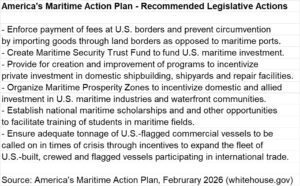
What does this mean for companies and investors? Like many government white papers, the Maritime Action Plan is loaded with recommendations and big ideas, many of which are unlikely to become reality. And the plan acknowledges that a number of its initiatives would require Congressional legislation (see below), many with funding required – not an easy task given partisan rancor in Washington, D.C, and high U.S. budget deficits. Nonetheless, the plan touches a nerve as both U.S. political parties have grown more concerned in recent years about reliance on China in a number of industries from pharmaceuticals to rare earths to solar panels. We do see the Trump Administration continuing its focus on domestic shipbuilding given its focus on reshoring American manufacturing activity and reducing dependence on foreign partners for critical infrastructure. Democrats would likely support many of the work streams outlined in the Action Plan as well, especially as the investments outlined would help both red and blue states (many U.S. shipyards are heavily staffed by union workers, a traditional Democrat constituency). A contact who attended a recent annual U.S. shipbuilding conference reported that attendance was double or more the year before, with discussions dominated by the Administration’s new maritime strategy.

Revitalizing the domestic shipbuilding industry and its related labor and supply chains will take years. But in the interim, other opportunities may well present themselves to maritime operators and their owners: domestically made and operated software to track ships; the aforementioned Maritime Prosperity Zones; and revitalized maritime education and training programs, just to name a few. In a fractious Washington – one in which control of the seas have come rapidly to the fore again through the recently U.S.-initiated conflict in the Gulf – the U.S. domestic maritime industry may well set sail.

Want to learn more? Reach out to GK’s U.S. partner Erin Caddell at e.caddell@anchor-advisors.net.

Anchors aweigh: A way for private investors to play potential Fannie, Freddie IPOs

By Erin Caddell, Anchor Advisors in partnership with GK Strategy

President Donald Trump’s second White House term has sparked discussion that his Administration might return the two U.S. Government Sponsored Enterprises (GSEs) to full public ownership after more than 16 years under federal control following their bailouts in the depths of the 2008 financial crisis. In May, Trump said his Administration is giving “serious consideration” to conducting IPOs for the GSEs. And in late July Bloomberg reported that the Administration was holding meetings with bankers interested in underwriting the IPOs.

Fannie Mae and Freddie Mac’s vital place in the US mortgage system make them compelling assets for investors to look at should the IPOs move forward. Critical to the nation’s economy, the complexities of these entities and the market they serve present challenges necessitating a multi-year transition period to full private ownership. As Fannie and Freddie have swept billions of dollars in profit back to the government in the post-conservatorship era, both companies would need to build up their capital to stand as independent companies. The GSEs’ equity combined represent only 2% of their total assets, far less than traditional banks or mortgage finance firms.

This is where anchor investors could play a role. Anchor investors (we promise we do not like this idea just because we also have Anchor in our name) take meaningful equity stakes in companies preparing to go public, agreeing to hold the positions for a given period post-IPO as a sign of confidence for other investors and to lessen the fundraising need for the company. For instance, in the 2022 IPO of Life Insurance Corp. (LIC), India’s largest insurer, anchor investors including Norges Bank (Norway’s sovereign wealth fund) and the Government of Singapore (GIC) investment fund purchased about 25% of the issue in advance of the IPO. Sometimes anchor investors receive a discount on their shares in exchange for taking down large chunks of the IPO and agreeing to hold their shares though a post-IPO lockup period.

One can imagine the appeal to the government of anchor investors in the GSE IPO process, particularly for the Trump Administration, focused as it is on boosting investment in the US. For that matter, any future presidential administration will be attracted to the idea of contributing hundreds of billions to federal coffers in an attempt to offset multi-trillion-dollar federal budget deficits. Anchor investors could allow the government to generate income from early sales early, as the GSE transition plan and public offerings would likely take several years. A combination of domestic and foreign sovereign wealth funds would be most desirable: the domestic players to emphasize the US’ ability to invest in itself; the global investors to highlight the international attraction to the US capital markets. Expressing interest in the GSE privatizations now would give anchor investors a shot of having a seat at the table if the deals come together.

For investors, a day-one commitment to the GSE IPOs would provide a unique opportunity to invest in scale players in the $14 trillion US mortgage market – about 70% of which is supported in some way by Fannie or Freddie. The GSEs operate as critical components of the US mortgage industry infrastructure, setting standards and ensuring liquidity for residential and multi-family mortgage markets. Such “utility” functions have been rewarded with handsome valuation multiples and stock performance across financial services, energy, technology and other sectors, including those whose protective moats are protected by government regulation. Indeed, in the years leading up to the Global Financial Crisis, Fannie and Freddie performed well in the equity markets, though critics argued their accomplishments were driven by overly aggressive balance-sheet practices and lobbying activities.

Risks abound when investing in entities with multi-trillion-dollar balance sheets, as the wipeout of billions of dollars in the GSE’s market caps demonstrated in 2008. Numerous issues must be worked out to return the GSEs to private hands, most notably the current federal backstop on Fannie and Freddie’s combined $7 trillion-plus in debt, the lion’s share of which is backed by the mortgages the two entities guarantee. Even a modest increase in borrowing rates on such a large debt load could result in a big hit to the GSE’s earnings post-IPO, necessitating a long period in which the federal backstop is withdrawn over time.

But these are risks that large, sophisticated investors are well-equipped to navigate. A once-in-a- chance to invest in unique, highly profitable and protected franchises critical to the US economy, and to build goodwill with a President attracted to out-of-the-box deals, make the GSE privatizations an opportunity worth considering.

Private firms poised to benefit from turmoil surrounding U.S. government economic data

By Erin Caddell, Anchor Advisors LLC, in partnership with GK Strategy

Controversy surrounding the U.S. government’s aggregator of economics data has shone a spotlight on privately held firms that gather comparable information. Private economic data-collection firms are likely to enjoy policy-driven tailwinds amidst a period of questioning of the validity of government statistics and pressure on federal spending.

President Trump fired Bureau of Labor Statistics (BLS) Commissioner Erika McEnterfer in August after a monthly employment report announced downward revisions of U.S. jobs created in May and June of more than 250,000, plus a less-than-expected reading of 73,000 new jobs in July (BLS reported 5 September that 22,000 jobs had been created in August). Trump claimed the jobs numbers were “rigged” to undermine his Administration (Trump ramped up his broadsides further following a 9 September BLS report that lowered its estimates of job creation in the year ending March 2025 by more than 900,000, the largest such revision in its history).

Trump has nominated E.J. Antoni, a Trump loyalist, chief economist of the conservative Heritage Foundation and a BLS critic, to replace McEnterfer as the next Commissioner. Antoni has suggested that if confirmed he may temporarily suspend release of the monthly employment report to validate its methodology. Critics argue Antoni is unqualified since he has never worked in government, while his predecessor spent 20 years at the U.S. Census Bureau and Treasury Department prior to her appointment. Antoni’s detractors have argued further that an overtly partisan Commissioner would undermine public perception of BLS.

Private economic data-collection firms have an opportunity to benefit regardless of Antoni’s fate. If Antoni is confirmed, analysts will mine BLS’ data for signs of political bias. If rejected, the agency will face months without a confirmed leader. Regardless, any sustained run of reported job losses would surely draw further ire from Trump, ratcheting pressure on BLS further. Additionally, the next Commissioner will have to reckon with lower funding and staffing. The Trump Administration has recommended to Congress that BLS’s budget be cut by 8% in F2026, with staffing reduced to an 11-year low (shown below), though this recommendation is subject to Congressional approval. The controversy appears to have already hit BLS’ workforce, with some one-third of leadership positions at the agency reportedly vacant.

U.S. Bureau of Labor Statistics (BLS) – Congressional Appropriation and Headcount

Fiscal year Appropriation FTEs
2016 609,000 2,195
2017 609,000 2,185
2018 612,000 2,022
2019 605,000 2,057
2020 655,000 1,961
2021 655,000 1,965
2022 687,952 1,949
2023 697,952 2,023
2024 697,952 2,058
2025 703,952 2,019
2026E 647,952 1,851

Source: U.S. Department of Labor. Note: F26E represents DOL’s recommendation to Congress.

Who to Watch

Several players appear positioned to leverage the opportunity to pick up the slack amidst concerns about validity of BLS data, including LinkUp, PriceStats and Yipitdata, as well as industry veterans ADP and Manpower.

LinkUp uses data sent directly by companies as well as publicly available information to provide analysis of national and local employment trends. LinkUp was acquired in November 2024 by GlobalData, a publicly traded U.K.-based firm (London stock ticker DATA). Lightcast provides a similar service, and last year was acquired by KKR. In the inflation arena, PriceStats is a self-funded firm founded in 2011, which uses public information to generate daily inflation reports in the U.S. and 24 other countries. Similarly, Yipitdata uses automated scans of millions of websites to assess changes in consumer behavior; Yipitdata raised $475m from Carlyle in 2021. Numerator is a startup that uses online surveys to help companies assess perceptions of their products and brands with consumers. While not exact parallels to BLS, these companies could reposition their businesses to more directly capture employment data.

The best-known alternative to the BLS is a monthly report produced by payroll administrator ADP. Similarly, staffing firm Manpower Group produces a quarterly survey on U.S. staffing trends. While less comprehensive than BLS’, there is an opportunity for ADP or Manpower to expand their data sets – and charge for the service – given the turmoil at BLS.

Historically, the federal government’s dominant place as the provider of U.S. economic data has made the notion of private-sector replacements seem woefully inadequate. Yet as with many developments in Trump’s second term, wishing for a “return to normal” is just that – a wish. The credibility of government economic data will continue to be questioned, while BLS’s funding and staffing pressures persist. The private sector has a clear opportunity to step in and fill the void.

Trump Administration deregulatory push yields industry wish list for rule rollbacks

By Erin Caddell, Anchor Advisors LLC – A GK Strategy partner firm

Amidst the mile-a-minute pace of activity in the Trump Administration’s first six months, the Office of Management and Budget (OMB)’s April 11th posting of Federal Register document 2025-06316, “Request for Information: Deregulation” did not exactly make for scintillating tabloid reading. Yet the effort initiated by OMB’s memo is likely to spark substantial regulatory activity by a number of federal agencies starting this fall and into the remainder of Trump’s current term that will be highly impactful across a range of industries in the U.S.

OMB’s request for information (RFI) was prepared in response to an Executive Order signed by President Trump on April 9th to repeal “[u]nlawful, unnecessary and onerous regulations”. The order notes that the U.S. Supreme Court has issued a number of rulings in recent years limiting the power of federal agencies, and asks commenters to identify regulations now inconsistent with these decisions.

Companies and their trade associations were only too happy to respond to OMB’s request. The RFI received nearly 8,500 comments during the 30-day window (though some were from individuals calling for caution against moving too quickly to deregulate). OMB and federal agencies will likely begin the process of repealing or amending certain rules cited in the comments starting this fall. Importantly, the executive order notes that agencies may attempt to rescind the rules in question without the traditional notice-and-comment period required for formal rulemaking, which can add months if not years to the process. The order cites a provision in the Administrative Procedures Act (APA) providing a “good cause” exemption to traditional rulemaking requirements if the original rule is “impracticable, unnecessary or contrary to the public interest.” Any attempts to circumvent the rulemaking process would be met immediately by legal challenges (interestingly, the Mortgage Bankers Association, an influential trade association, argued that agencies should continue to utilize the notice-and-comment process, as abandoning this function could rob industry with a key means of providing input). But even if ultimately overturned, companies would have to make accommodations to assume a proposed repeal could become effective, particularly if intermediate courts support the Administration.

So what does Corporate America hope to deregulate? Anchor reviewed a representative sample of comment letters submitted by trade associations representing a range of industries. We summarize in the table below recommendations from six of these comments. Taken together, the missives describe their authors’ frustrations with the blizzard of rulemaking under the Biden Administration and cite hundreds of regulations they believe should be repealed or revised in the name of spurring economic growth and reducing the administrative burden.

Select Industry Association Responses to OMB Deregulation Request for Input (RFI)

Organization Rule cited Agency(s) Year Commenter’s rationale
Mortgage Bankers Association (MBA) Adoption of energy efficiency standards for new construction of HUD- and USDA-financed housing HUD, USDA 2024 Will drive up costs for new single-family and multi-family construction; 30 states still operating under prior standard enacted in 2009; shortage of inspectors trained on new standard.
National Multifamily Housing Council/National Apartment Association Floodplain management and protection of wetlands HUD 2024 Imposes substantial compliance costs on homeowners without robust data on actual risk reduction benefits nationwide.
Information Technology and Innovation Foundation Rule requiring minimum of two crew members on most US freight and passenger train journeys. Federal Railroad Administration 2024 Lacks foundation in safety data; is driven by labor-union pressures; automated braking systems and other technological advances intended to mitigate accidents caused by human error.
American Petroleum Institute (API) National Ambient Air Quality Standards (NAAQS) for Particulate Matter EPA 2024 In 2024, EPA mandated a lowering of maximum air particulate matter – a measure of air quality – of no more than 9.0 micrograms per cubic meter vs. 12.0 previously. API argues no new scientific evidence had emerged to warrant such a reduction. API argues the new standard will limit economic growth. The group supports revising, not repealing the rule.
Small Business Low Risk Coalition (group of manufacturing/industrial trade associations) Multi-sector general permit rules for stormwater discharge from industrial facilities EPA 2021 Argues 2021 version of standard was issued in overly hasty fashion relative to the 2015 version, which received lengthy multiagency review. The group argues that the 2021 permit rules added costly, unnecessary analytical monitoring requirements for many industries.
American Hospital Association (AHA) Remove telehealth originating and geographic site restrictions within the Medicare program. CMS Various Currently, Medicare patients in urban or suburban areas do not have the same access to telehealth services covered by Medicare as those in rural areas; in other cases patients must be in a clinical setting to receive telehealth services, which defeats their purpose.

Source: Regulations.gov

What does this mean for investors and companies? The OMB request for information and its many industry responses are a sign that deregulation – obscured thus far by the trade war, the immigration crackdown and the many controversies that follow the current Administration – will nonetheless be a key theme for Trump’s second term. The fall Unified Regulatory Agenda, a document published by presidential Administrations twice a year that details each federal agency’s priorities for the coming 12 months, will provide clues as to how the Administration has translated OMB’s fact-finding mission into agency priorities.

Given the inclination of Trump, Vought and those around them in the Administration, OMB is likely to push ahead with many of the deregulatory recommendations put forth in the comment letters. Opponents will attempt to counter these efforts through the courts, with their allies in Congress, and by attempting to influence public opinion. But as with many other aspects of the Trump Administration, critics will face the challenge of fighting many battles at once.

History also shows that deregulation can be a double-edged sword for the private sector. The Global Financial Crisis of 2007-08, which followed a long period of loosened of the U.S. financial services industry, is the most striking recent example. But more recent cases like the collapse of Silicon Valley Bank in spring 2023 demonstrate the dangers of lighter-touch regulation. In that case, rule changes reducing capital and liquidity requirements for banks of Silicon Valley’s size encouraged the firm to increase its risk profile, making the firm highly vulnerable to a rise in short-term interest rates. Companies must do more on their own to protect their businesses, customers and employees at times when the pendulum swings toward deregulation. Ethics committees, ombudsmen and similar compliance measures (Anchor and its partners can help with this!) can serve companies well at times like this when animal spirits are running high – on Wall Street as well as in Washington, D.C.

Tariff climbdown offers Trump an off ramp, but uncertainty remains

History repeats itself. An adage the US President and his team of advisers would do well to heed.

In 2022 the radical tax cutting budget announced by Liz Truss’ government sent yields on UK gilts spiralling out of control, with the 10-year gilt yield increasing by the largest amount in a single day since the 1990s. The Bank of England had to intervene with emergency bond purchases to prevent a collapse in the pension fund market.

This market crisis ultimately had profound political consequences, with Kwasi Kwarteng being removed as Chancellor after just 38 days in office, and the end of Liz Truss’s premiership following soon after, making her the shortest-serving Prime Minister in UK history at only 49 days.

The episode highlighted how sensitive financial markets can be to fiscal policy decisions, particularly when they raise concerns about a country’s debt sustainability or when policy changes are announced without adequate preparation or buy-in from the market.

We can look further back to understand the might of the bond market. President Clinton’s economic adviser, James Carville, said: “I used to think that if there was reincarnation, I wanted to come back as the President or the pope or as a .400 baseball hitter. But now I would want to come back as the bond market. You can intimidate everybody.” This has arguably proved to be the case for President Trump – despite trillions being wiped off the stock market, it was rising yields on US Treasury bonds that forced him to blink.

The President claims that the decision to pause the new reciprocal tariff regime for 90 days was the result of 75 countries contacting the White House to express willingness to negotiate trade deals. This narrative creates a potential blueprint for a further watering down of tariffs once the pause ends. Trump has created some leeway to say that after successful negotiations countries will no longer be “ripping off” the United States and will point to his tariffs as a masterstroke in political and economic diplomacy. This exit strategy, however, may come too late to repair the damage done to the international economic and geopolitical order that Trump’s approach is likely to leave in its wake.

This short reprieve, as it may still turn out to be, is creating major issues for the global economy, with financial markets in a state of flux trying to pre-empt and then respond to Trump’s next move. The political and economic uncertainty of the next three months will be difficult to navigate, particularly for multinational businesses with complex supply chains.

UK Prime Minister Sir Keir Starmer has already acknowledged that fixating on whether the UK can negotiate the removal of its own 10% tariff is almost irrelevant, given the potentially more serious impacts the UK could face in the event of a global economic slowdown. A trade war between the two biggest global economies – the United States and China – would have far reaching implications that no country would be able to insulate itself from. The Bank of England has already warned that supply chain disruptions would be expected to weigh heavy on UK economic activity.

This all creates a big headache for the Chancellor of the Exchequer, Rachel Reeves. Having had to make some politically unpopular decisions in recent week to restore the £9billion of fiscal headroom she identified in the autumn budget in October, she could once again find this headroom wiped out as UK growth is revised down. There is already speculation about HM Treasury’s potential response. Tax rises, more spending cuts, or additional borrowing are the options, and none of them are politically palatable.

The global economic challenges have already had an impact on the machinery of government. The Prime Minister has removed two key people from the Number 10 policy unit as part of efforts for the government to speed up economic growth and policy delivery. In the coming weeks it is likely the government will bring forward the publication of the government’s Industrial Strategy (originally scheduled for publication alongside the Spending Review in June) to demonstrate that the UK is open to business and ripe for international investment. The government has also shown a willingness to support industries that are exposed to tariffs.  In anticipation of tariffs coming into effect, Starmer announced a watering down of regulations relating to electric vehicle sales targets to provide manufacturers with some breathing space. We are likely to see additional measures announced as the government continues its consultation with business on the impacts of higher tariffs, and what the UK’s response should be.

The government is facing a significant challenge to its central mission to grow the economy and raise living standards. A renewed emphasis to go further and faster in the delivery of its reform agenda, does, despite the doom and gloom, offer an opportunity for businesses. Policymakers are firmly in listening mode. Businesses that can offer solutions to the economic pressures the government is facing, as well as a commitment to investing in the UK, will find a welcoming ear.

The next few months will undoubtedly be challenging and uncertain. However, a renewed collaboration between the public and private sector to navigate these turbulent times has the potential to offer a pathway for the UK to position itself as a top destination for investment and business growth.