Category Archives: Trump Administration

View from the US: Wealth taxes and universal income

Erin Caddell of GK Strategy’s American partner Anchor Advisors unpacks the prospect of wealth taxes on ultra-high net worth individuals and universal basic income to address heightened scrutiny of wealth inequality in the US

Stunning rise in tech wealth reignites policy debate about U.S. income inequality

The dramatic increase in market capitalization among US-based AI and other tech-related companies in recent years, encapsulated by last week’s whopper IPO for SpaceX, is reinvigorating a long-running debate about income inequality in America. Proposals for redistributive policies, such as wealth taxes and universal basic income (UBI), are gaining a new currency in US state capitals and in Washington DC.

The wealth creation of the AI boom is staggering. The SpaceX IPO made founder Elon Musk the world’s first trillionaire. Following Musk, the next nine richest Americans have a collective net worth of $1.7 trillion according to Forbes. All but one of whom (Warren Buffett) is a tech co-founder. Americans for Tax Fairness, a tax advocacy group, estimated that the net worth of America’s roughly 1,000 billionaires has increased by $1.5 trillion in 2025 to $8.2 trillion. Much of the rise is being driven by AI’s boost to tech content and infrastructure providers (as well as the tax cuts approved by President Trump and the GOP-controlled Congress last year).

The achievements of the ultra-rich in harnessing the promise of the latest technology revolution have drawn the ire of everyday Americans grappling with high inflation, increased healthcare costs and the threat of jobs being displaced by AI. This shift in public sentiment is turning on its head an old adage that Americans do not support higher taxes on the wealthy because many believe they, too, will become rich one day in the land of opportunity. A YouGov poll released in January found that 59% of Americans surveyed agreed that the government should pursue policies that narrow the gap between the rich and poor, with a majority of those Republicans surveyed agreeing that the wealth gap is a big problem. Compare this to 1939, when a Fortune magazine poll found only 35% of Americans surveyed felt wealth should be redistributed through higher taxes on the rich.

Policymakers looking for support to address income inequality can point to evidence that the gap between rich and poor is even wider now than in the Gilded Age of the late 19th century when the technologies of the Industrial Revolution created the first cohort of the ultra-wealthy in America; and ultimately a backlash that led to the antitrust actions around the turn of the century, and later to establishment of the federal income tax in 1916.

Gabriel Zucman, a leading international scholar of wealth inequality, published a book in May with the wonderfully direct title ‘We Need to Tax Billionaires’. It found that the wealth of the top 0.0001% of the world’s richest families represented more than 16% of world GDP in 2025, up from 4% in 1910, and 3% in the mid-1980s.

The early skirmishes on the income-inequality debate are playing out in the American states, where public sentiment can be codified into policy more quickly than at the federal level. Earlier this year, the legislation in Washington state (home of Microsoft and Amazon) was passed and its governor signed a new 9.9% state tax on annual incomes above US$1 million. Massachusetts has levied a 4% surcharge on $1 million-plus earners since 2022. Colorado, Connecticut, Hawaii, Michigan, New York and Rhode Island are considering similar measures.

California, the epicenter of both the AI revolution and worries about thousands of jobs being made obsolete by it, recently submitted enough signatures to place a ‘billionaires’ tax’ on the November 2026 ballot. The measure would impose a one-time 5% tax on California residents with net worth of greater than $1bn, a move projected to raise US$100 billion to fund healthcare, education and food assistance. The initiative has already roiled the state and potentially national politics. California Governor, and likely 2028 Democratic presidential candidate Gavin Newsom, has opposed the measure, arguing it would hurt the state’s tech industry. Labor unions that initiated the proposal are considering a compromise to lower the proposed tax to 2%.

Universal basic income (UBI) is the flip side of the wealth tax. Dating back centuries, UBI intends to provide a modest but unconditional income to all citizens of a society to recognize the dignity and value of each person and to share the benefits of a nation’s bounty. The idea has gained new currency amidst renewed concern in recent years about displacement of workers by technology. Twitter founder Jack Dorsey gave $15 million to a group called the Mayors for a Guaranteed Income to divide into a series of UBI pilot programs. UBI pilots have been launched in recent years in cities including Stockton, California; Durham, North Carolina; and Baltimore, Maryland.

With Trump and the GOP focused on lowering taxes rather than raising them, wealth levies and UBI programs are non-starters at the federal level now. This could change. Democrats are making income inequality a key plank in their campaign for the November midterm elections. Should Democrats win back the White House and gain control of both houses of Congress in 2028 (as Biden and his party did in 2020), they would likely consider wealth-tax proposals already circulating among party leaders. The ‘Billionaires’ Income Tax’ bill proposed in September 2025, for instance, would subject individual taxpayers with assets of greater than US$1 billion or annual income of more than $100 million a year for three consecutive years to an annual tax based on the net gain of their assets (or to deduct the losses). The bill was proposed in the Senate by Finance Committee Ranking Member Ron Wyden (D-OR), a leading voice in Democratic tax policy, and co-sponsored by 20 Democratic Senators.

While UBI has less support at the federal level than wealth taxes, UBI could also gain favor in a Democrat-controlled White House, Senate and House. In October 2025, a dozen Democratic House members led by Rep. Bonnie Watson Coleman (D-NJ) introduced the Guaranteed Income Pilot Program Act, which would provide income equivalent to rent for a two-bedroom apartment for an initial test group of 20,000 Americans. Even Musk himself has become a proponent of UBI, posting on X in April that ‘Universal HIGH INCOME via checks issued by the Federal government is the best way to deal with unemployment caused by AI’.

Individual federal income-tax rates have declined in the US from 91% in 1955 (a vestige of increases to help pay for World War II) to 37% in 2025, while capital-gains taxes have held around 25% over the past decade, according to the Peterson Foundation (see below). Not coincidentally, the entrepreneur has risen in the eyes of the American public during this period, as the ’Organization Man’ archetype of the loyal cog in the paternalistic corporation gave way to the us-against-the-world mindset of the U.S. tech industry, best symbolized by the foundings of Apple and Microsoft in the mid-1970s.

Through the commercialization of the internet in the mid-1990s, to the rise of social media 20 years later, to the acceleration of generative AI with the launch of ChatGPT in 2022, technology has become ever-more central to the U.S. economy and society. Yet the widening gap between the few at the top and the rest below seems to have driven a policy tipping point. With the federal deficit at 6% of GDP, the highest in U.S. history outside of war and the covid-19 pandemic, and individual tax receipts the largest source of federal revenue at 50%, it seems a question of when, not if U.S. policymakers will have to consider raising taxes. The ultra-wealthy are an easy target as part of such an effort. At the same time, pressure to distribute more of the benefits of the tech boom to the rank-and-file who bear its brunt also seems poised to continue to rise through increased support for UBI, as well as for higher standard deductions for federal income taxes, as multiple progressive policymakers have proposed recently.

What does this mean for US-focused investors and corporates?

We do not profess to be able to predict when or by how much tax rates on wealthy Americans will rise. But we do see several downstream effects impacting US-centric companies and their owners from the increased focus on income inequality.

First, a redistributive shift in the tax system would be positive for firms that help individuals and small businesses prepare their income taxes (yes, including those who assist wealthy people in looking for ways to pay less in tax), as well as the many companies that provide services to the tax-preparation industry itself.

Second, companies and investors should be more prepared to view their actions in the U.S. through a more populist lens and to delineate the benefits of their products and services beyond the limited traditional corporate stakeholders of shareholders, customers and employees. Take data centers. In recent years, the tech firms developing the data centers powering the AI boom, led by the multi-billionaires highlighted above, believed the substantial tax revenue they planned to bring to mostly rural or suburban communities where data centers are located would be enough to win support from local citizens. With many local governments across the political spectrum working to halt data-center construction due to concerns about resource utilization and quality of life, developers must take a more holistic approach, thinking through ways to offset the centers’ electricity and water usage; expanding efforts to reduce noise and other potential environmental impacts; and partnering with impacted communities to share in the benefits of the center’s economic activity beyond just paying a tax bill.

Third, should UBI proposals gain further support at the state or federal level, it would help providers of affordable housing, an industry already under the spotlight at the federal and state level as many regions of the U.S. deal with housing affordability issues and shortages.

Whatever the outcome of these and similar debates, income inequality and policies to address it are sure to occupy a larger place in the U.S. policy landscape in years to come.


 

View from the US: the Republican congressional agenda

Erin Caddell of GK Strategy’s American partner Anchor Advisors unpacks the Republican congressional agenda ahead of the midterm elections taking place in November

Over the decades, American conservative political thought has often manifested itself in treatises that have called for sweeping policy changes, often employed as rallying cries heading into elections. The Mandate for Leadership, published in 1979 by the right-wing think tank Heritage Foundation, laid the groundwork in part for Ronald Reagan’s presidency starting in 1981, detailing proposals for lowering regulations on industry, reining in the influence of the federal bureaucracy and cutting taxes to spur economic growth that continue in conservative orthodoxy to this day. The 1994 Contract with America served as the blueprint for then-U.S. Rep. Newt Gingrich and his GOP colleagues to seize control of the House of Representatives later that year for the first time in 40 years, proposing a series of reforms to social programs, tax and spending cuts and changes in the workings of government itself. And Project 2025, chaired by Heritage with support from numerous U.S. conservative groups, provided a detailed plan for a conservative presidency, from domestic to trade to foreign policy, many elements of which have been enacted or attempted in Trump’s second presidential term.

With the U.S. midterm elections now less than six months away, what is the conservative manifesto of 2026? It is notable that across a number of conservative groups aligned with the Trump Administration and current GOP leadership in Congress – Heritage, America First Policy Institute, Conservative Partnership Institute, American Compass – there exists no recent document summarizing an overarching conservative policy vision. Yet with all 435 members of the House of Representatives and one-third of the Senate up for election in November, it is valid to ask what more the GOP hopes to do should it defy history – as we have pointed out in prior editions of this column, the president’s party has lost House seats in 18 of 20 midterm elections held since 1946 – and maintain control of both houses of Congress for the final two years of Trump’s second term. Even if Republicans lose control of the House and/or the Senate, the policy proposals they put forth today will guide their actions as a minority party in Congress; the ways in which they support Trump’s executive actions in 2027 and 2028; and even, yes, how the party moves beyond the Trump presidential era with a new Republican candidate for president in November 2028.

To address this question, we focus on a January 2026 report, “Restoring America’s Golden Age”, released by the Republican Study Committee (RSC), a group of 188 conservative House members (87% of the total 217 current House Republicans). The RSC report is structured as a high-level annual federal budget proposal. Continuing the spirit of the Department of Government Efficiency (DOGE) initiative early in Trump’s second term, the RSC identifies numerous federal programs for funding reduction or elimination it views as wasteful or unnecessarily driven by progressive ideology (see below).

Select programs targeted for reduced or zero funding by the Republican Study Committee

Program Agency
National Institute of Food and Agriculture Agriculture
Office of the Under Secretary of Farm Production and Conservation Agriculture
Climate Hubs Agriculture
Manufacturing Extension Partnership Commerce
National Institute of Standards and Technology Commerce
National Science Foundation NM
Environmental and Natural Resources Division Justice
Equal Employment Opportunity Commission NM
Office of Clean Energy Demonstrations Energy
Advanced Research Projects Agency – Energy (ARPA-E) Energy
State and Community Energy Programs Energy
Federal Insurance Office Treasury
Entrepreneurial Development Program Small Business
EPA Research and Development Environment
Diesel Emissions Reduction Act Grants Environment

Source: Republican Study Committee, Restoring America’s Golden Age, 07.01.2026


We detail two of the policy themes outlined in the report we view as especially relevant for US-focused investor and corporate clients of Anchor and GK: tax and defense policy:

1. Tax – don’t get too comfortable. The RSC report makes clear that Republicans continue to view the tax system as an activist policy tool even following last year’s passage of the One Big Beautiful Bill (OBBB), which expanded and made permanent a number of the corporate and individual tax cuts enacted during Trump’s first year as president. The report speaks glowingly of Trump’s decision on his first day in office in his second term to withdraw from a deal negotiated by the international Organisation of Economic Co-operation and Development (OECD) during the Biden Administration to impose a global minimum tax rate and other restrictions on multi-national corporations. RSC members and other critics argued the OECD deal was unfair to U.S.-based international corporations. In response, RSC member Rep. Jason Smith (R-MO), chairman of the tax-writing House Ways & Means Committee, introduced a bill in 2025 to impose retaliatory taxes on U.S.-active companies and investors whose countries levy selective taxes on U.S. firms, targeting in particular the digital services taxes (DSTs) that have been imposed on multinational tech firms by the UK and some EU Member states. Nicknamed the “revenge tax” or the Section 899 tax for the new title of the U.S. code it would have created, global investors breathed a sigh of relief when the provision was removed from the OBBB following opposition from a number of foreign entities active in U.S. markets. However, the RSC whitepaper is one reminder that the protectionist Republican sentiment that led the Section 899 bill to be proposed is still very much alive within the conservative Republican caucus, and could return under a future GOP-controlled Congress or White House.  The RSC budget also supports other tax policies that reflect the populist, anti-corporate sentiment prevalent in today’s GOP, including ending the tax-exempt status of bonds sold to finance professional sports stadiums.

2. Defense – Hawks unbowed. Even before the start of the U.S. and Israeli military action against Iran in late February, a number of Republicans had joined Democrats in criticizing President Trump’s January 2026 proposal to increase U.S. defense spending in the coming fiscal year to US$1.5 trillion, some 44% higher than current levels. The RSC proposal is a good reminder that while some in the GOP argued Trump’s number was too high, support for the U.S. defense sector runs deep among conservative Republicans. The RSC whitepaper is supportive of numerous new defense spending initiatives, from expanded missile production to accelerated shipbuilding, enhanced cyber-security defenses to increased support for domestic rare-earths production to reduce dependence on China as a source of critical minerals needed for military equipment. Interestingly, the RSC report endorses “sustained American support for our NATO allies,” including funding for “frontline NATO states through defense cooperation and deterrent capabilities – one area of potential daylight between the House GOP conservatives and their president.  But “Restoring America’s Golden Age” highlights that support for the U.S. military – and higher defense spending – remains a core tenet of both the Trump Administration and congressional conservatives (the RSC has released several statements supporting Trump’s Iran strategy since the war’s start). Should Republicans maintain control of Congress into 2027, Trump and his allies would likely take another run at securing a big jump in defense spending during his last two years as president, regardless of the Iran conflict’s outcome.

Trump’s Maritime Strategy Opens New Waters for U.S. Shipbuilding Industry

By Erin Caddell, Anchor Advisors, in partnership with GK Strategy

A recently announced Trump Administration plan for the U.S. maritime industry is likely to open new opportunities for U.S.-focussed companies, investors, training businesses and even real-estate developers interested in reigniting the domestic shipbuilding industry and its related value chain – while presenting commensurate challenges in invigorating an industry that has been forsaken in favor of foreign competitors for decades.

Entitled “America’s Maritime Action Plan”, the proposal released last month responds to a long-held but still shocking fact: that despite boasting the world’s largest economy, a long history of engineering and technological innovation at sea, and over 150,000 kilometers (95,000 miles) of shoreline, less than 1% of the world’s ships are built in the U.S.

It was not always so. U.S. shipbuilding was key to Allied success in both world wars. The U.S. remained the world’s largest shipbuilder as late as 1975, according to the U.S. Trade Representative. The decline of domestic shipbuilding echoes that of many American manufacturing sectors in the post-World War II era, with foreign countries using cost advantages in labor and materials to siphon away an industry once dominated by American companies. Today, 74% of the world’s commercial ships, 80% of ship-to-shore cranes and 96% of shipping containers are built in China, according to the White House. U.S. reliance on foreign shipping presents a national-security risk commonly cited by Republicans and Democrats as rivalry between China and the U.S. has intensified.

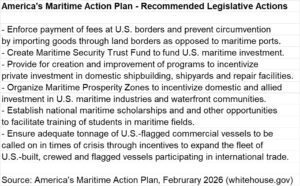
The Maritime Action Plan was set in motion by an executive order signed by President Trump in April 2025 and attempts to address this imbalance. It focuses on four pillars: 1) Rebuild domestic shipbuilding capacity; 2) Reform maritime workforce education and training; 3) Protect the maritime industrial base; and 4) Enhance national security, industrial security, and industrial resilience.

The Action Plan also recommends establishing Maritime Prosperity Zones (MPZs) would be modeled on the Opportunity Zones (OpZones) included in the Tax Cuts and Jobs Act (TCJA), the tax bill passed by Trump Administration and the Republican-controlled Congress in 2017. OpZones are census tracts designated as economically distressed areas where investors can receive tax benefits for long-term investments. OpZones were made permanent and the tax incentives expanded further in federal legislation passed in July 2025. The Action Plan recommends establishing 100 MPZs, ensuring these areas are geographically diverse and include regions outside traditional coastal shipbuilding centers.

What does this mean for companies and investors? Like many government white papers, the Maritime Action Plan is loaded with recommendations and big ideas, many of which are unlikely to become reality. And the plan acknowledges that a number of its initiatives would require Congressional legislation (see below), many with funding required – not an easy task given partisan rancor in Washington, D.C, and high U.S. budget deficits. Nonetheless, the plan touches a nerve as both U.S. political parties have grown more concerned in recent years about reliance on China in a number of industries from pharmaceuticals to rare earths to solar panels. We do see the Trump Administration continuing its focus on domestic shipbuilding given its focus on reshoring American manufacturing activity and reducing dependence on foreign partners for critical infrastructure. Democrats would likely support many of the work streams outlined in the Action Plan as well, especially as the investments outlined would help both red and blue states (many U.S. shipyards are heavily staffed by union workers, a traditional Democrat constituency). A contact who attended a recent annual U.S. shipbuilding conference reported that attendance was double or more the year before, with discussions dominated by the Administration’s new maritime strategy.

Revitalizing the domestic shipbuilding industry and its related labor and supply chains will take years. But in the interim, other opportunities may well present themselves to maritime operators and their owners: domestically made and operated software to track ships; the aforementioned Maritime Prosperity Zones; and revitalized maritime education and training programs, just to name a few. In a fractious Washington – one in which control of the seas have come rapidly to the fore again through the recently U.S.-initiated conflict in the Gulf – the U.S. domestic maritime industry may well set sail.

Want to learn more? Reach out to GK’s U.S. partner Erin Caddell at e.caddell@anchor-advisors.net.

Anchors aweigh: A way for private investors to play potential Fannie, Freddie IPOs

By Erin Caddell, Anchor Advisors in partnership with GK Strategy

President Donald Trump’s second White House term has sparked discussion that his Administration might return the two U.S. Government Sponsored Enterprises (GSEs) to full public ownership after more than 16 years under federal control following their bailouts in the depths of the 2008 financial crisis. In May, Trump said his Administration is giving “serious consideration” to conducting IPOs for the GSEs. And in late July Bloomberg reported that the Administration was holding meetings with bankers interested in underwriting the IPOs.

Fannie Mae and Freddie Mac’s vital place in the US mortgage system make them compelling assets for investors to look at should the IPOs move forward. Critical to the nation’s economy, the complexities of these entities and the market they serve present challenges necessitating a multi-year transition period to full private ownership. As Fannie and Freddie have swept billions of dollars in profit back to the government in the post-conservatorship era, both companies would need to build up their capital to stand as independent companies. The GSEs’ equity combined represent only 2% of their total assets, far less than traditional banks or mortgage finance firms.

This is where anchor investors could play a role. Anchor investors (we promise we do not like this idea just because we also have Anchor in our name) take meaningful equity stakes in companies preparing to go public, agreeing to hold the positions for a given period post-IPO as a sign of confidence for other investors and to lessen the fundraising need for the company. For instance, in the 2022 IPO of Life Insurance Corp. (LIC), India’s largest insurer, anchor investors including Norges Bank (Norway’s sovereign wealth fund) and the Government of Singapore (GIC) investment fund purchased about 25% of the issue in advance of the IPO. Sometimes anchor investors receive a discount on their shares in exchange for taking down large chunks of the IPO and agreeing to hold their shares though a post-IPO lockup period.

One can imagine the appeal to the government of anchor investors in the GSE IPO process, particularly for the Trump Administration, focused as it is on boosting investment in the US. For that matter, any future presidential administration will be attracted to the idea of contributing hundreds of billions to federal coffers in an attempt to offset multi-trillion-dollar federal budget deficits. Anchor investors could allow the government to generate income from early sales early, as the GSE transition plan and public offerings would likely take several years. A combination of domestic and foreign sovereign wealth funds would be most desirable: the domestic players to emphasize the US’ ability to invest in itself; the global investors to highlight the international attraction to the US capital markets. Expressing interest in the GSE privatizations now would give anchor investors a shot of having a seat at the table if the deals come together.

For investors, a day-one commitment to the GSE IPOs would provide a unique opportunity to invest in scale players in the $14 trillion US mortgage market – about 70% of which is supported in some way by Fannie or Freddie. The GSEs operate as critical components of the US mortgage industry infrastructure, setting standards and ensuring liquidity for residential and multi-family mortgage markets. Such “utility” functions have been rewarded with handsome valuation multiples and stock performance across financial services, energy, technology and other sectors, including those whose protective moats are protected by government regulation. Indeed, in the years leading up to the Global Financial Crisis, Fannie and Freddie performed well in the equity markets, though critics argued their accomplishments were driven by overly aggressive balance-sheet practices and lobbying activities.

Risks abound when investing in entities with multi-trillion-dollar balance sheets, as the wipeout of billions of dollars in the GSE’s market caps demonstrated in 2008. Numerous issues must be worked out to return the GSEs to private hands, most notably the current federal backstop on Fannie and Freddie’s combined $7 trillion-plus in debt, the lion’s share of which is backed by the mortgages the two entities guarantee. Even a modest increase in borrowing rates on such a large debt load could result in a big hit to the GSE’s earnings post-IPO, necessitating a long period in which the federal backstop is withdrawn over time.

But these are risks that large, sophisticated investors are well-equipped to navigate. A once-in-a- chance to invest in unique, highly profitable and protected franchises critical to the US economy, and to build goodwill with a President attracted to out-of-the-box deals, make the GSE privatizations an opportunity worth considering.

Private firms poised to benefit from turmoil surrounding U.S. government economic data

By Erin Caddell, Anchor Advisors LLC, in partnership with GK Strategy

Controversy surrounding the U.S. government’s aggregator of economics data has shone a spotlight on privately held firms that gather comparable information. Private economic data-collection firms are likely to enjoy policy-driven tailwinds amidst a period of questioning of the validity of government statistics and pressure on federal spending.

President Trump fired Bureau of Labor Statistics (BLS) Commissioner Erika McEnterfer in August after a monthly employment report announced downward revisions of U.S. jobs created in May and June of more than 250,000, plus a less-than-expected reading of 73,000 new jobs in July (BLS reported 5 September that 22,000 jobs had been created in August). Trump claimed the jobs numbers were “rigged” to undermine his Administration (Trump ramped up his broadsides further following a 9 September BLS report that lowered its estimates of job creation in the year ending March 2025 by more than 900,000, the largest such revision in its history).

Trump has nominated E.J. Antoni, a Trump loyalist, chief economist of the conservative Heritage Foundation and a BLS critic, to replace McEnterfer as the next Commissioner. Antoni has suggested that if confirmed he may temporarily suspend release of the monthly employment report to validate its methodology. Critics argue Antoni is unqualified since he has never worked in government, while his predecessor spent 20 years at the U.S. Census Bureau and Treasury Department prior to her appointment. Antoni’s detractors have argued further that an overtly partisan Commissioner would undermine public perception of BLS.

Private economic data-collection firms have an opportunity to benefit regardless of Antoni’s fate. If Antoni is confirmed, analysts will mine BLS’ data for signs of political bias. If rejected, the agency will face months without a confirmed leader. Regardless, any sustained run of reported job losses would surely draw further ire from Trump, ratcheting pressure on BLS further. Additionally, the next Commissioner will have to reckon with lower funding and staffing. The Trump Administration has recommended to Congress that BLS’s budget be cut by 8% in F2026, with staffing reduced to an 11-year low (shown below), though this recommendation is subject to Congressional approval. The controversy appears to have already hit BLS’ workforce, with some one-third of leadership positions at the agency reportedly vacant.

U.S. Bureau of Labor Statistics (BLS) – Congressional Appropriation and Headcount

Fiscal year Appropriation FTEs
2016 609,000 2,195
2017 609,000 2,185
2018 612,000 2,022
2019 605,000 2,057
2020 655,000 1,961
2021 655,000 1,965
2022 687,952 1,949
2023 697,952 2,023
2024 697,952 2,058
2025 703,952 2,019
2026E 647,952 1,851

Source: U.S. Department of Labor. Note: F26E represents DOL’s recommendation to Congress.

Who to Watch

Several players appear positioned to leverage the opportunity to pick up the slack amidst concerns about validity of BLS data, including LinkUp, PriceStats and Yipitdata, as well as industry veterans ADP and Manpower.

LinkUp uses data sent directly by companies as well as publicly available information to provide analysis of national and local employment trends. LinkUp was acquired in November 2024 by GlobalData, a publicly traded U.K.-based firm (London stock ticker DATA). Lightcast provides a similar service, and last year was acquired by KKR. In the inflation arena, PriceStats is a self-funded firm founded in 2011, which uses public information to generate daily inflation reports in the U.S. and 24 other countries. Similarly, Yipitdata uses automated scans of millions of websites to assess changes in consumer behavior; Yipitdata raised $475m from Carlyle in 2021. Numerator is a startup that uses online surveys to help companies assess perceptions of their products and brands with consumers. While not exact parallels to BLS, these companies could reposition their businesses to more directly capture employment data.

The best-known alternative to the BLS is a monthly report produced by payroll administrator ADP. Similarly, staffing firm Manpower Group produces a quarterly survey on U.S. staffing trends. While less comprehensive than BLS’, there is an opportunity for ADP or Manpower to expand their data sets – and charge for the service – given the turmoil at BLS.

Historically, the federal government’s dominant place as the provider of U.S. economic data has made the notion of private-sector replacements seem woefully inadequate. Yet as with many developments in Trump’s second term, wishing for a “return to normal” is just that – a wish. The credibility of government economic data will continue to be questioned, while BLS’s funding and staffing pressures persist. The private sector has a clear opportunity to step in and fill the void.