Category Archives: Government Relations

Risk-based or sector led? How we can expect the government to regulate AI

Elon Musk’s AI chatbot, Grok, has received significant backlash in recent weeks after its ability to create sexualised images of women and children generated widespread media headlines.  The scale of the public outcry has sharpened concerns about how quickly AI capabilities are outpacing existing safeguards. This has increased pressure on the government to more stringently regulate AI, which is reshaping industries at an unprecedented pace, bringing both opportunities and risks.

Prime Minister Keir Starmer previously suggested that the government would move away from the last Conservative administration’s ‘pro-innovation regulatory framework’ for AI, as set out in its white paper on AI published in 2023. Instead, Starmer has publicly emphasised the need for an overarching regulatory framework with additional protections in specific areas. He has also expressed concerns about the potential risks and impacts of AI, while acknowledging its transformative potential for society. In January 2025, the government published its AI Opportunities Action Plan, which set out its ambitions to use AI to ‘turbocharge’ economic growth and create AI growth zones to speed up planning processes for AI infrastructure.

The government’s approach to AI differs from the EU’s risk-based framework, which classifies AI systems into four categories: unacceptable risk, high risk, limited risk, and minimal risk. Each category has a different set of regulations and requirements for organisations developing or using AI systems. UK-based organisations with operations in the EU or those deploying AI systems within the bloc are likely to fall under the jurisdiction of the EU AI Act, requiring UK organisations to keep abreast of legislative changes and any potential future misalignments between the UK and EU in this area.

Although Starmer has pledged to turn the UK into an ‘AI superpower’, ministers have so far struggled to find the right balance between regulation and harnessing AI’s economic potential. At the end of 2024, the government proposed relaxing copyright laws to allow developers to train AI models on any material they can legally access. The plans received widespread criticism from creatives and high-profile musicians who would be required to opt-out of having their work used. Ministers have since acknowledged that the move was misguided and announced that the associated legislation would be delayed while they develop a more extensive policy framework.

It is likely that we will see new legislation announced in the form of an AI and Copyright Bill at the King’s speech, which is due to take place in May 2026. This presents an opportunity for businesses to engage with the government at a key stage of the policymaking process.

The legislation is likely to focus on safety, copyright protections, and transparency. The government has been clear that it does not want to introduce measures that could drive AI investment out of the UK. Appearing before the Digital and Communications Committee in January 2026, technology secretary Liz Kendall stated that many of the larger AI companies are opposed to ‘onerous burdens’, suggesting the government is likely to adopt a cautious approach in its efforts to more stringently regulate AI to avoid deterring potential investment in the UK.

This means we can expect the government to attempt to tread a line between the EU’s risk-based framework and the deregulatory approach taken in the US in order to strike the right balance between innovation and oversight. Despite both the EU and UK focussing on principles such as accountability and transparency, the diverging approaches observed so far in practice mean a consistent approach to the regulation of AI is unlikely, at least in the near term.

If you would like to discuss AI regulation in more detail, please reach out to Annabelle Black at annabelle@gkstrategy.com.

Labour Party Conference 2025 Takeaways

As the party departs Liverpool, still clearly grappling with the challenges of what being the party of government brings, we’ve learned a lot about the direction the party is going. Here are our quick takeaways.

Keir Starmer has shored up his position…for now. With the noise going into this conference all about the leadership challenge from Manchester’s Andy Burnham, the sight of his early departure from conference before the PM’s speech will please No.10. In what could have been a perilous week for the PM, strong reaffirmation of the Chancellor’s fiscal rules, coupled with strong defences from cabinet ministers and aides, resulted in Burnham conceding that Starmer is the “right person for the job”. You can’t help but add the line “for the moment…” with other rising stars like Shabana Mahmood and Wes Streeting clearly biding their time.

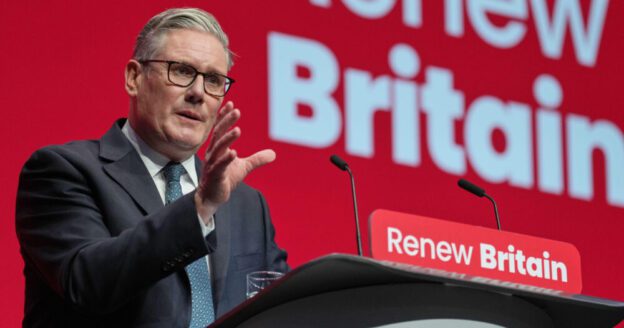
Labour is taking the fight to reform. In what was probably his strongest speech as party leader, Starmer clearly set the parameters for British politics. For him, this is about Labour vs Reform. Decency vs division. Ultimately, the class-conscious speech was a deliberate attempt to win back the working class that has increasingly abandoned the party over the years to the likes of Reform. In this more combative approach, he also decried Reform’s policies on immigration as “racist”. A punchy line of attack which worked in the room, but he will hope doesn’t unravel as a perceived attack on all Reform sympathisers who are doubting the centrist parties’ ability to deliver.

The looming budget has not got any easier. In media briefings over the weekend, and in her speech, Rachel Reeves continued the manifesto commitment to not raise taxes on working people. Whilst at the same time, to appease critical voices in the Labour party, she is flirting with the idea of more spending – both on infrastructure and lifting the two-child limit. She said she is a chancellor that wants to invest. None of this sounds like a chancellor staring down the prospect of having to find £30bn in November to plug the gap predicted by the OBR.

The difference a Labour government makes. This has been the underlying strategic narrative of the conference to fend off criticism there is no difference between this government and a Conservative one. We saw speech after speech rattle off long lists of tangible activities the government has taken across the policy spectrum.  We can expect much more of this narrative to come, together with a clear focus on ‘showing’ that delivery to the electorate, rather than just ‘telling‘ them.

Policy spotlight: the future of the UK food system


https://gkstrategy.com/wp-content/uploads/2025/09/GK-Strategy-Policy-Spotlight-Report-The-Future-of-the-UK-Food-System-September-2025.pdf


GK Strategy – Policy Spotlight Report – The Future of the UK Food System


GK is delighted to share its first policy spotlight report on the food and agriculture sectors where geo-political, economic and health priorities increasingly collide.

From tackling obesity and diet-related ill-heath to food security and investor appetite for agri-tech innovation, the government’s policy agenda is ambitious. Our report explores:


  • The future of food and health: analysis of the government’s more interventionist stance on obesity, sugar reform and the development of a new national food strategy.
  • Innovation in agriculture: why agri-tech is now a priority in the UK’s industrial strategy and where the opportunities lie for businesses to partner with government.
  • Investor sentiment: how food, agriculture and natural capital are performing as asset classes and where private capital flow is likely to follow.
  • The view from the US: how the political and regulatory landscape in the US is evolving and how this might shape UK markets.


With the government eager to demonstrate delivery and progress towards much-needed economic growth, businesses and investors have a critical window of opportunity to shape policy and regulation. This policy spotlight report highlights where the engagement opportunities lie, how to align with government priorities, and how to mitigate regulatory and political risks while unlocking commercial growth.

To explore the findings of this report in more detail and what they mean for your organisations, please reach out to thea@gkstrategy.com.

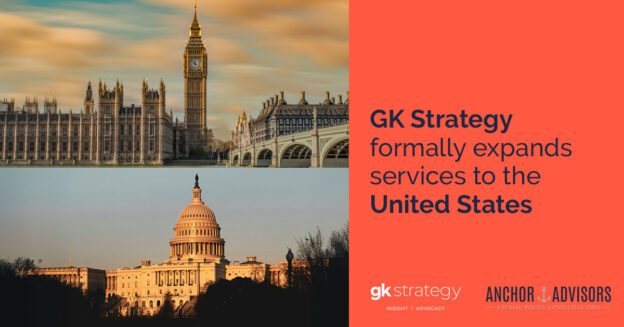
GK Strategy Formally Expands Political Advisory Services to United States

GK has agreed a formal strategic partnership with Washington DC based Anchor Advisors to provide integrated insights for private equity investors navigating transatlantic M&A transactions.

GK Strategy is delighted to announce its formal expansion to the United States, to support its private-asset investor clients navigate and engage with policymaking at a federal and state level.

The partnership brings together GK Strategy’s deep expertise in the UK’s policy and regulatory environment with Anchor Advisors’ experience of supporting private equity investors navigate US policy at a state and federal level. The two firms will support private equity and private credit clients and their portfolio companies by providing robust insight to better anticipate regulatory change, assess political risk, and identify opportunities in both markets.

Louise Allen, CEO of GK Strategy said: “We’re delighted to announce the formal partnership between GK Strategy and Anchor Advisors. Private-asset investments are increasingly being shaped by fast-moving policy developments which have the potential to have significant impacts on the commercial environments for businesses operating in both the UK and the US.

Private equity and private credit firms, and the companies they own, are also increasingly looking beyond their traditional geographies to identify compelling investment opportunities, and to limit their exposure to any single region. GK’s partnership with Anchor Advisors means we can offer our clients a clear, connected perspective on how regulatory shifts in London and Washington could impact valuations, deal structures, and long-term strategies.”

Erin Caddell, President of Anchor Advisors, added: “Investors want certainty and foresight. Our partnership allows us to deliver precisely that, by providing clients with comprehensive analysis that spans both sides of the Atlantic, from opportunities presented by US federal and state government action to sector-specific funding trends.”

The partnership reflects a growing demand from private equity and private credit investors for tailored political and regulatory intelligence. By combining local insight with international perspective, GK Strategy and Anchor Advisors will support investors not only to mitigate risk but also to identify new growth opportunities in an increasingly complex global policy environment.

The new international advisory service will be led by Lizzie Wills, Senior Partner and Head of Private Equity at GK Strategy, and President of Anchor Advisors Erin Caddell.

For more information about GK’s US coverage, or to arrange an introductory meeting with the GK team in Washington D.C, please be in touch with Lizzie Wills on lizzie.wills@gkstrategy.com or 07456 794 568.