
Category Archives: United States

Trump’s Maritime Strategy Opens New Waters for U.S. Shipbuilding Industry

By Erin Caddell, Anchor Advisors, in partnership with GK Strategy

A recently announced Trump Administration plan for the U.S. maritime industry is likely to open new opportunities for U.S.-focussed companies, investors, training businesses and even real-estate developers interested in reigniting the domestic shipbuilding industry and its related value chain – while presenting commensurate challenges in invigorating an industry that has been forsaken in favor of foreign competitors for decades.

Entitled “America’s Maritime Action Plan”, the proposal released last month responds to a long-held but still shocking fact: that despite boasting the world’s largest economy, a long history of engineering and technological innovation at sea, and over 150,000 kilometers (95,000 miles) of shoreline, less than 1% of the world’s ships are built in the U.S.

It was not always so. U.S. shipbuilding was key to Allied success in both world wars. The U.S. remained the world’s largest shipbuilder as late as 1975, according to the U.S. Trade Representative. The decline of domestic shipbuilding echoes that of many American manufacturing sectors in the post-World War II era, with foreign countries using cost advantages in labor and materials to siphon away an industry once dominated by American companies. Today, 74% of the world’s commercial ships, 80% of ship-to-shore cranes and 96% of shipping containers are built in China, according to the White House. U.S. reliance on foreign shipping presents a national-security risk commonly cited by Republicans and Democrats as rivalry between China and the U.S. has intensified.

The Maritime Action Plan was set in motion by an executive order signed by President Trump in April 2025 and attempts to address this imbalance. It focuses on four pillars: 1) Rebuild domestic shipbuilding capacity; 2) Reform maritime workforce education and training; 3) Protect the maritime industrial base; and 4) Enhance national security, industrial security, and industrial resilience.

The Action Plan also recommends establishing Maritime Prosperity Zones (MPZs) would be modeled on the Opportunity Zones (OpZones) included in the Tax Cuts and Jobs Act (TCJA), the tax bill passed by Trump Administration and the Republican-controlled Congress in 2017. OpZones are census tracts designated as economically distressed areas where investors can receive tax benefits for long-term investments. OpZones were made permanent and the tax incentives expanded further in federal legislation passed in July 2025. The Action Plan recommends establishing 100 MPZs, ensuring these areas are geographically diverse and include regions outside traditional coastal shipbuilding centers.

What does this mean for companies and investors? Like many government white papers, the Maritime Action Plan is loaded with recommendations and big ideas, many of which are unlikely to become reality. And the plan acknowledges that a number of its initiatives would require Congressional legislation (see below), many with funding required – not an easy task given partisan rancor in Washington, D.C, and high U.S. budget deficits. Nonetheless, the plan touches a nerve as both U.S. political parties have grown more concerned in recent years about reliance on China in a number of industries from pharmaceuticals to rare earths to solar panels. We do see the Trump Administration continuing its focus on domestic shipbuilding given its focus on reshoring American manufacturing activity and reducing dependence on foreign partners for critical infrastructure. Democrats would likely support many of the work streams outlined in the Action Plan as well, especially as the investments outlined would help both red and blue states (many U.S. shipyards are heavily staffed by union workers, a traditional Democrat constituency). A contact who attended a recent annual U.S. shipbuilding conference reported that attendance was double or more the year before, with discussions dominated by the Administration’s new maritime strategy.
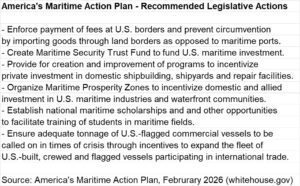
Revitalizing the domestic shipbuilding industry and its related labor and supply chains will take years. But in the interim, other opportunities may well present themselves to maritime operators and their owners: domestically made and operated software to track ships; the aforementioned Maritime Prosperity Zones; and revitalized maritime education and training programs, just to name a few. In a fractious Washington – one in which control of the seas have come rapidly to the fore again through the recently U.S.-initiated conflict in the Gulf – the U.S. domestic maritime industry may well set sail.

Want to learn more? Reach out to GK’s U.S. partner Erin Caddell at e.caddell@anchor-advisors.net.


Anchors aweigh: A way for private investors to play potential Fannie, Freddie IPOs

By Erin Caddell, Anchor Advisors in partnership with GK Strategy

President Donald Trump’s second White House term has sparked discussion that his Administration might return the two U.S. Government Sponsored Enterprises (GSEs) to full public ownership after more than 16 years under federal control following their bailouts in the depths of the 2008 financial crisis. In May, Trump said his Administration is giving “serious consideration” to conducting IPOs for the GSEs. And in late July Bloomberg reported that the Administration was holding meetings with bankers interested in underwriting the IPOs.

Fannie Mae and Freddie Mac’s vital place in the US mortgage system make them compelling assets for investors to look at should the IPOs move forward. Critical to the nation’s economy, the complexities of these entities and the market they serve present challenges necessitating a multi-year transition period to full private ownership. As Fannie and Freddie have swept billions of dollars in profit back to the government in the post-conservatorship era, both companies would need to build up their capital to stand as independent companies. The GSEs’ equity combined represent only 2% of their total assets, far less than traditional banks or mortgage finance firms.

This is where anchor investors could play a role. Anchor investors (we promise we do not like this idea just because we also have Anchor in our name) take meaningful equity stakes in companies preparing to go public, agreeing to hold the positions for a given period post-IPO as a sign of confidence for other investors and to lessen the fundraising need for the company. For instance, in the 2022 IPO of Life Insurance Corp. (LIC), India’s largest insurer, anchor investors including Norges Bank (Norway’s sovereign wealth fund) and the Government of Singapore (GIC) investment fund purchased about 25% of the issue in advance of the IPO. Sometimes anchor investors receive a discount on their shares in exchange for taking down large chunks of the IPO and agreeing to hold their shares though a post-IPO lockup period.

One can imagine the appeal to the government of anchor investors in the GSE IPO process, particularly for the Trump Administration, focused as it is on boosting investment in the US. For that matter, any future presidential administration will be attracted to the idea of contributing hundreds of billions to federal coffers in an attempt to offset multi-trillion-dollar federal budget deficits. Anchor investors could allow the government to generate income from early sales early, as the GSE transition plan and public offerings would likely take several years. A combination of domestic and foreign sovereign wealth funds would be most desirable: the domestic players to emphasize the US’ ability to invest in itself; the global investors to highlight the international attraction to the US capital markets. Expressing interest in the GSE privatizations now would give anchor investors a shot of having a seat at the table if the deals come together.

For investors, a day-one commitment to the GSE IPOs would provide a unique opportunity to invest in scale players in the $14 trillion US mortgage market – about 70% of which is supported in some way by Fannie or Freddie. The GSEs operate as critical components of the US mortgage industry infrastructure, setting standards and ensuring liquidity for residential and multi-family mortgage markets. Such “utility” functions have been rewarded with handsome valuation multiples and stock performance across financial services, energy, technology and other sectors, including those whose protective moats are protected by government regulation. Indeed, in the years leading up to the Global Financial Crisis, Fannie and Freddie performed well in the equity markets, though critics argued their accomplishments were driven by overly aggressive balance-sheet practices and lobbying activities.

Risks abound when investing in entities with multi-trillion-dollar balance sheets, as the wipeout of billions of dollars in the GSE’s market caps demonstrated in 2008. Numerous issues must be worked out to return the GSEs to private hands, most notably the current federal backstop on Fannie and Freddie’s combined $7 trillion-plus in debt, the lion’s share of which is backed by the mortgages the two entities guarantee. Even a modest increase in borrowing rates on such a large debt load could result in a big hit to the GSE’s earnings post-IPO, necessitating a long period in which the federal backstop is withdrawn over time.

But these are risks that large, sophisticated investors are well-equipped to navigate. A once-in-a- chance to invest in unique, highly profitable and protected franchises critical to the US economy, and to build goodwill with a President attracted to out-of-the-box deals, make the GSE privatizations an opportunity worth considering.

GK Strategy Formally Expands Political Advisory Services to United States

GK has agreed a formal strategic partnership with Washington DC based Anchor Advisors to provide integrated insights for private equity investors navigating transatlantic M&A transactions.

GK Strategy is delighted to announce its formal expansion to the United States, to support its private-asset investor clients navigate and engage with policymaking at a federal and state level.

The partnership brings together GK Strategy’s deep expertise in the UK’s policy and regulatory environment with Anchor Advisors’ experience of supporting private equity investors navigate US policy at a state and federal level. The two firms will support private equity and private credit clients and their portfolio companies by providing robust insight to better anticipate regulatory change, assess political risk, and identify opportunities in both markets.

Louise Allen, CEO of GK Strategy said: “We’re delighted to announce the formal partnership between GK Strategy and Anchor Advisors. Private-asset investments are increasingly being shaped by fast-moving policy developments which have the potential to have significant impacts on the commercial environments for businesses operating in both the UK and the US.

Private equity and private credit firms, and the companies they own, are also increasingly looking beyond their traditional geographies to identify compelling investment opportunities, and to limit their exposure to any single region. GK’s partnership with Anchor Advisors means we can offer our clients a clear, connected perspective on how regulatory shifts in London and Washington could impact valuations, deal structures, and long-term strategies.”

Erin Caddell, President of Anchor Advisors, added: “Investors want certainty and foresight. Our partnership allows us to deliver precisely that, by providing clients with comprehensive analysis that spans both sides of the Atlantic, from opportunities presented by US federal and state government action to sector-specific funding trends.”

The partnership reflects a growing demand from private equity and private credit investors for tailored political and regulatory intelligence. By combining local insight with international perspective, GK Strategy and Anchor Advisors will support investors not only to mitigate risk but also to identify new growth opportunities in an increasingly complex global policy environment.

The new international advisory service will be led by Lizzie Wills, Senior Partner and Head of Private Equity at GK Strategy, and President of Anchor Advisors Erin Caddell.

For more information about GK’s US coverage, or to arrange an introductory meeting with the GK team in Washington D.C, please be in touch with Lizzie Wills on lizzie.wills@gkstrategy.com or 07456 794 568.

Private firms poised to benefit from turmoil surrounding U.S. government economic data

By Erin Caddell, Anchor Advisors LLC, in partnership with GK Strategy

Controversy surrounding the U.S. government’s aggregator of economics data has shone a spotlight on privately held firms that gather comparable information. Private economic data-collection firms are likely to enjoy policy-driven tailwinds amidst a period of questioning of the validity of government statistics and pressure on federal spending.

President Trump fired Bureau of Labor Statistics (BLS) Commissioner Erika McEnterfer in August after a monthly employment report announced downward revisions of U.S. jobs created in May and June of more than 250,000, plus a less-than-expected reading of 73,000 new jobs in July (BLS reported 5 September that 22,000 jobs had been created in August). Trump claimed the jobs numbers were “rigged” to undermine his Administration (Trump ramped up his broadsides further following a 9 September BLS report that lowered its estimates of job creation in the year ending March 2025 by more than 900,000, the largest such revision in its history).

Trump has nominated E.J. Antoni, a Trump loyalist, chief economist of the conservative Heritage Foundation and a BLS critic, to replace McEnterfer as the next Commissioner. Antoni has suggested that if confirmed he may temporarily suspend release of the monthly employment report to validate its methodology. Critics argue Antoni is unqualified since he has never worked in government, while his predecessor spent 20 years at the U.S. Census Bureau and Treasury Department prior to her appointment. Antoni’s detractors have argued further that an overtly partisan Commissioner would undermine public perception of BLS.

Private economic data-collection firms have an opportunity to benefit regardless of Antoni’s fate. If Antoni is confirmed, analysts will mine BLS’ data for signs of political bias. If rejected, the agency will face months without a confirmed leader. Regardless, any sustained run of reported job losses would surely draw further ire from Trump, ratcheting pressure on BLS further. Additionally, the next Commissioner will have to reckon with lower funding and staffing. The Trump Administration has recommended to Congress that BLS’s budget be cut by 8% in F2026, with staffing reduced to an 11-year low (shown below), though this recommendation is subject to Congressional approval. The controversy appears to have already hit BLS’ workforce, with some one-third of leadership positions at the agency reportedly vacant.

U.S. Bureau of Labor Statistics (BLS) – Congressional Appropriation and Headcount

Fiscal year Appropriation FTEs
2016 609,000 2,195
2017 609,000 2,185
2018 612,000 2,022
2019 605,000 2,057
2020 655,000 1,961
2021 655,000 1,965
2022 687,952 1,949
2023 697,952 2,023
2024 697,952 2,058
2025 703,952 2,019
2026E 647,952 1,851

Source: U.S. Department of Labor. Note: F26E represents DOL’s recommendation to Congress.

Who to Watch

Several players appear positioned to leverage the opportunity to pick up the slack amidst concerns about validity of BLS data, including LinkUp, PriceStats and Yipitdata, as well as industry veterans ADP and Manpower.

LinkUp uses data sent directly by companies as well as publicly available information to provide analysis of national and local employment trends. LinkUp was acquired in November 2024 by GlobalData, a publicly traded U.K.-based firm (London stock ticker DATA). Lightcast provides a similar service, and last year was acquired by KKR. In the inflation arena, PriceStats is a self-funded firm founded in 2011, which uses public information to generate daily inflation reports in the U.S. and 24 other countries. Similarly, Yipitdata uses automated scans of millions of websites to assess changes in consumer behavior; Yipitdata raised $475m from Carlyle in 2021. Numerator is a startup that uses online surveys to help companies assess perceptions of their products and brands with consumers. While not exact parallels to BLS, these companies could reposition their businesses to more directly capture employment data.

The best-known alternative to the BLS is a monthly report produced by payroll administrator ADP. Similarly, staffing firm Manpower Group produces a quarterly survey on U.S. staffing trends. While less comprehensive than BLS’, there is an opportunity for ADP or Manpower to expand their data sets – and charge for the service – given the turmoil at BLS.

Historically, the federal government’s dominant place as the provider of U.S. economic data has made the notion of private-sector replacements seem woefully inadequate. Yet as with many developments in Trump’s second term, wishing for a “return to normal” is just that – a wish. The credibility of government economic data will continue to be questioned, while BLS’s funding and staffing pressures persist. The private sector has a clear opportunity to step in and fill the void.